
About
The Africa Urban Resilience Programme

Driving Inclusive and Risk-Informed Urban Development Across Africa
Africa’s focus on building urban resilience is an urgent, critical development issue. The AU’s Africa Urban Resilience Programme (AURP) is providing the framework to achieve this goal.
Africa’s rapid urbanisation has intensified disaster risks, with cities increasingly vulnerable to some of the world’s most severe climate and hazard impacts. To address these pressing issues, the African Union Commission (AUC), with financial support from the Government of Sweden and the technical support of the United Nations Development Programme (UNDP), developed the Africa Urban Resilience Programme (AURP).
The Africa Urban Resilience Programme (AURP), implementation will be actively supported by the German Government through the GIZ’s Resilience Initiative Africa Project, provides a continent-wide framework to address these challenges.

Introducing the AURP
The Africa Urban Resilience Programme (AURP) was developed by the African Union Commission (AUC) with the support of the Government of Sweden and the United Nations Development Programme (UNDP) through the Sahel Resilience Project. The programme's implementation is supported by generous contributions of partners, including the Government of Germany through the GIZ's Resilience Initiative Africa Project.
The AURP is the continental framework aiming to strengthen regional and national urban risk management policies, plans and institutional capacities of member states to address urban risks.
Additionally, the European Union, through the 11th European Development Fund (EDF) Intra-ACP Natural Disaster Risk Programme, played a catalytic role in supporting the development of the AURP.
This robust and continent-wide framework was designed to guide and support urban resilience initiatives across Africa. In February 2024, the Africa Urban Resilience Programme was endorsed by AU Member States and the Executive Council.
Programme Objective
The overall objective of the AURP is to strengthen urban resilience in Africa through integrated, evidence-based and risk-informed planning and practice.
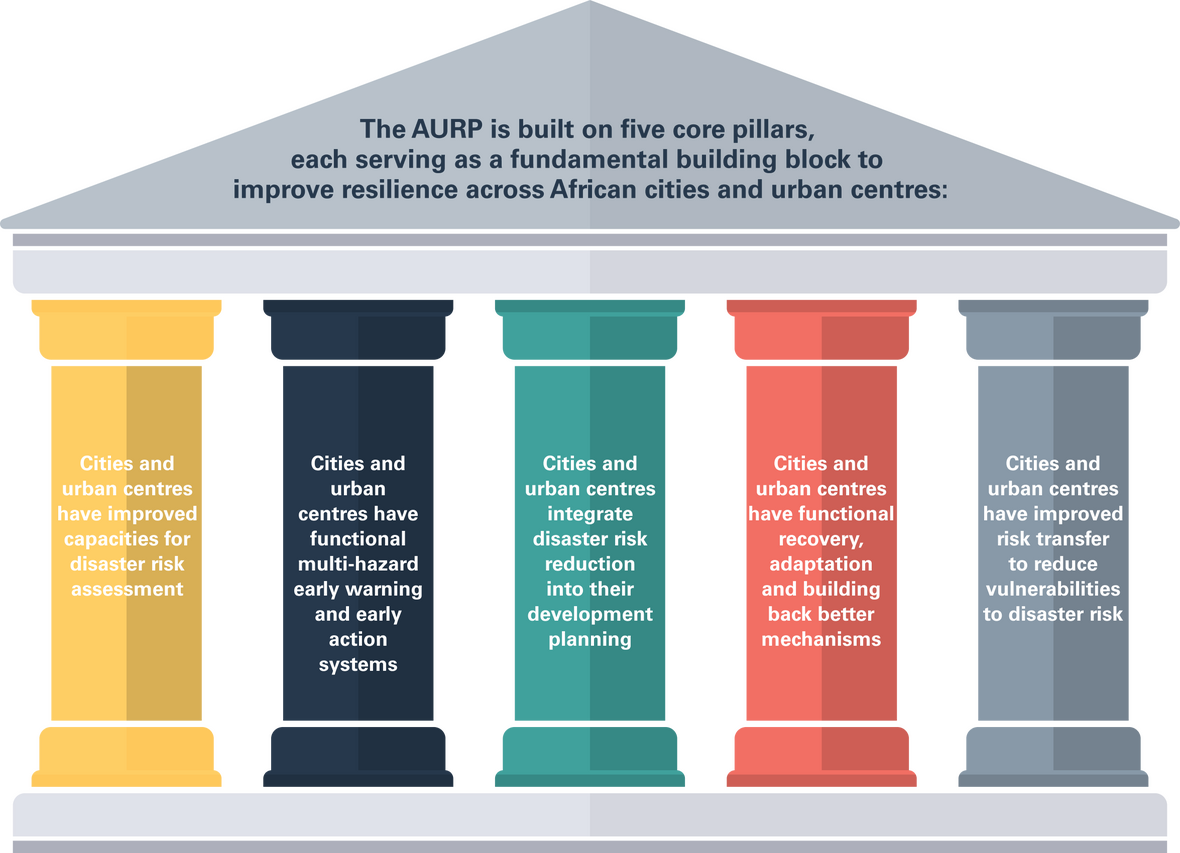
Pillars
Reframing Urban Resilience in Africa
The AURP’s key considerations and opportunities
A better understanding of urban resilience
Resilience-building through the inclusion of supporting functions in community and society moves resilience beyond merely the scientific analysis of systems. It brings to attention the embeddedness of “management” risk through the role of governance, institutions and the ability to gather knowledge and learn.
Scale, spatial distribution and geographic diversity
The diversity in spatial distribution and local manifestations of disaster risks allows for a deeper understanding of the interconnecting and cascading effects that disasters often set off. These should be taken into consideration to contextualise proposed strategies and action plans.
Rural-urban linkage of urban risk
This programme focuses on addressing urban risks in Africa, recognising the relationship, connection and driving factors of rural areas to the production of urban risk is important. Understanding the interconnectivity between rural and urban dimensions contributes to an appreciation of the wider systems of urbanisation within which risks and development manifest.
Gender and social inclusion dimensions of disaster risk
Gender and youth are important dimensions for any efforts aimed at reducing vulnerabilities of communities, highlighting that social inclusion is fundamental to building resilience. It is therefore important that this is reflected through data and analytics, institutional, capacity building, programmatic and implementation lens at different levels (regional, national and local).
Risk assessments and risk-informed data
The utility of risk assessments, tools and data to support risk-informed decision-making and policy also requires the requisite political support, which the AUC can provide in a targeted fashion. It calls for support for a more comprehensive approach to collecting risk and disaster data at the urban and intra-urban level as well as support for the use of participatory approaches by local policymakers to verify and triangulate information and build the capacities of constituencies to support better data collection processes.
Conflict and urban disaster risk
There is a need to recognise and address the strained capacity and preparedness of local governments in addressing basic welfare needs, services or disrupted livelihoods of people who have been displaced or migrating in conflict-affected areas. Peace and security are fundamental requirements for governance systems to operate to deliver resilience-building measures.
Gender and social inclusion dimensions of disaster risk
Gender and youth are important dimensions for any efforts aimed at reducing vulnerabilities of communities, and social inclusion is fundamental to building resilience. It is therefore important that this is reflected through data and analytics, institutional, capacity building, programmatic and implementation lenses at different levels (regional, national and local).
Risk assessments and risk-informed data
The utility of risk assessments, tools and data to support risk-informed decision-making and policy also requires the requisite political support, which the AUC can provide in a targeted fashion. It calls for support for a more comprehensive approach to collecting risk and disaster data at the urban and intra-urban scale as well as support for the use of participatory approaches by local policymakers to verify and triangulate information and build the capacities of constituencies to support better data collection processes.
Emergent shocks and manifestation of urban risk
Emergent shocks as COVID-19, re-emphasised the need for accelerated efforts to provide resilient basic services such as safe water and sanitation in urban areas and how that is essential to curbing cascading impacts such as the spread of infectious diseases and contributing to wellbeing and resilience.
Impact
The programme will contribute to a substantial reduction in urban disaster losses in Africa. Reduced disaster losses through risk-informed interventions in an inclusive, transboundary, multidisciplinary and participatory context will support thriving socio-economic development in urban centres across Africa.
Download the Africa Urban Resilience Programme
The AURP and its Partners
The African Union Commission has partnered with UNDP, UN-Habitat and the United Nations Environment Programme under the Aqinile Partnership and collaborated with GIZ’s Resilience Initiative Africa to support the implementation of the AURP. This joint effort aims to strengthen the capacity of Member States in building urban resilience. The AURP is the backbone of Africa’s urban resilience agenda and focuses on building the knowledge, networks and momentum needed to ensure a resilient urban future for all.
The AURP is implemented by the DRR Unit of the Sustainable Environment and Blue Economy Directorate of the AUC.